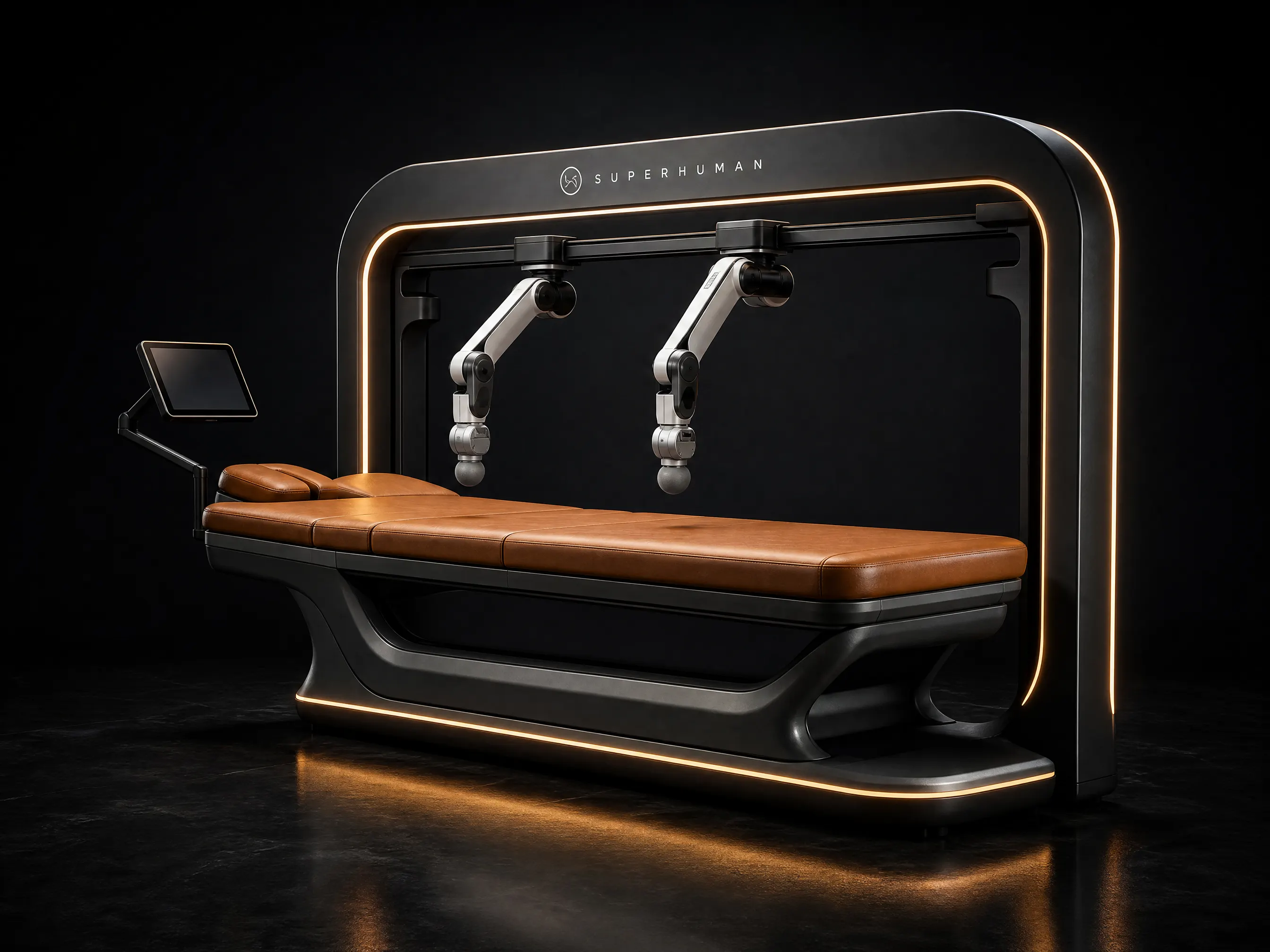
A massage robot is a machine that delivers a massage using one or more robotic arms, guided by sensors and software. The guest lies on a table, the robot maps their body, and the arms follow a programmed routine with pressure the guest controls. Most massage robots are commercial machines sold to gyms, spas, hotels and clinics, not home devices.
This guide explains what counts as a massage robot, the main types, how they differ from massage chairs, and the terms you will see when you shop for one.
A simple definition
A massage robot has three parts that work together:
- Arms. One or two articulated robotic arms, similar in principle to the arms used in factories, with a soft end piece that touches the body.
- Sensors. Cameras or depth sensors that build a map of the body, plus force sensors that measure how hard the arm presses.
- Software. Routines that tell the arms where to move, how fast and with how much pressure, and safety rules that stop or limit motion.
Put together, those parts let a machine deliver a massage that adapts to the person on the table. A massage chair or a handheld massage gun cannot do that in the same way, because their movement is fixed by the hardware.
For a deeper look at the mechanics, read how massage robots work.
Why the term is confusing
Search for “massage robot” and you will see massage chairs, handheld devices, toys and lab projects mixed in with real commercial systems. There are a few reasons:
- Sellers list robots as one product among many. There is no clear “massage robots” category on most retail or supplier sites. A robot often sits next to dozens of massage chairs.
- “Robotic” is used loosely. Some massage chairs are marketed as “robotic” because they have motors and programs. That does not make them robots in the sense used here.
- The category is new. Commercial massage robots have only been on the market for a few years, so there is no settled vocabulary yet.
A practical test: if the device has articulated arms that move freely over the body, guided by a body scan, it is a massage robot. If its massage parts move along a fixed track inside a seat, it is a massage chair.
Types of massage robots
Dual-arm table robots
The most common commercial format. A padded massage table sits under a frame or rail that carries two robotic arms. The arms work on both sides of the body at once, a bit like a therapist’s two hands.
- Strengths: full-body coverage, balanced pressure, sessions of 30 to 60 minutes.
- Trade-offs: needs a dedicated room, a dedicated power circuit and a larger budget.
- Example: the Superhuman Touch T1 is a dual-arm table robot. It has a 2.4 x 1.6 m footprint and runs on a dedicated 120 V or 240 V, 20 A circuit.
Single-arm robots
One robotic arm mounted beside a table or on a mobile base. It works on one area at a time.
- Strengths: smaller footprint, lower cost, simpler setup.
- Trade-offs: slower full-body coverage, and only one point of contact at a time.
- Best for: studios and clinics with limited space, or targeted sessions on the back and shoulders.
More Superhuman models are on the way.
Research and lab robots
Universities and research groups build massage robots to study touch, force control and human-robot interaction. These are not products you can buy for a business, but they show where the technology is going.
Superhuman Touch T1
A full-body massage that never calls in sick.
- Arms
- 2 robotic arms
- Session
- 30–60 min
- Guest
- Stays clothed
- Power
- 120/240 V · 20 A
Massage robots vs robotic massage chairs
This is the comparison most buyers need. A short version:
| Massage robot | Massage chair | |
|---|---|---|
| Format | Table with one or two articulated arms | Reclining seat with built-in rollers and airbags |
| Movement | Free movement over the body, guided by a scan | Fixed tracks inside the seat |
| Fit to the body | 3D body scan before each session | Basic body-height detection on many models |
| Pressure control | Force sensors, pressure set by the guest | Preset intensity levels |
| Body areas | Back, shoulders, neck, glutes, legs | Mainly back, neck, seat, calves and feet |
| Typical buyer | Businesses | Homes and some businesses |
| Typical price | About $13,000 to $150,000 commercial | Often a few thousand dollars |
| Space | A private room of about 3 x 2.6 m | A corner of a room |
Neither is “better” in every case. A chair is cheaper and smaller. A robot gives a session closer to a table massage and supports a paid, bookable service. Read the full massage robot vs massage chair comparison.
Key terms you will see
| Term | Meaning |
|---|---|
| End effector | The part of the arm that touches the body, usually a soft, padded tool |
| Degrees of freedom | How many ways an arm can move or rotate; more means more flexible motion |
| Body scan / body mapping | A 3D map of the guest’s body taken before the session so the routine fits |
| Force sensing | Measuring how hard the arm presses, in real time |
| Force limiting | A software and hardware cap on how much pressure the arm can apply |
| Collision detection | Detecting unexpected contact and stopping or backing off |
| Routine | A programmed sequence of movements for set body areas and length |
| Stop button | A control within the guest’s reach that halts the session at once |
| Operator dashboard | The staff screen used to start sessions, view status and see alerts |
| Remote monitoring | The manufacturer can see machine status and push software updates |
| Throughput | How many guests a machine can serve per hour, including changeover |
Who buys massage robots
Massage robots are mostly sold to businesses that want to offer massage at more hours than they can staff:
- Gyms and recovery studios add a bookable recovery service. See massage robots for gyms.
- Day spas cover early, late and weekend hours. See massage robots for spas.
- Hotels and resorts offer a 24/7 wellness amenity. See massage robots for hotels.
- Physical therapy and chiropractic clinics offer a wellness add-on alongside clinician-led care. See massage robots for physical therapy.
A massage robot does not replace a skilled massage therapist. It covers hours and capacity. Read massage robot vs massage therapist for an honest comparison.
What a massage robot costs
Prices in the commercial market fall into three rough bands:
- Entry systems: about $13,000 to $23,000.
- Mid-range systems: around $60,000.
- Flagship systems: about $125,000 to $150,000.
Leasing offers in the market start around $2,700 a month. The Superhuman Touch T1 sits in the mid band at $64,900, with financing of about $1,350 a month over 60 months (OAC), and you own the machine. Electricity runs about $40 to $80 a month. Read massage robot cost for the full breakdown.
Is a massage robot safe?
Commercial massage robots are designed with several layers of safety: force limits, a stop button within reach, collision detection and remote monitoring. They are wellness devices, not medical devices. Anyone with a health condition should talk to their physician before a session. Our massage robot safety guide covers screening, cleaning and supervision in detail.
Next steps
See every model available now in massage robots for sale, read the T1 product page, or contact us with questions.