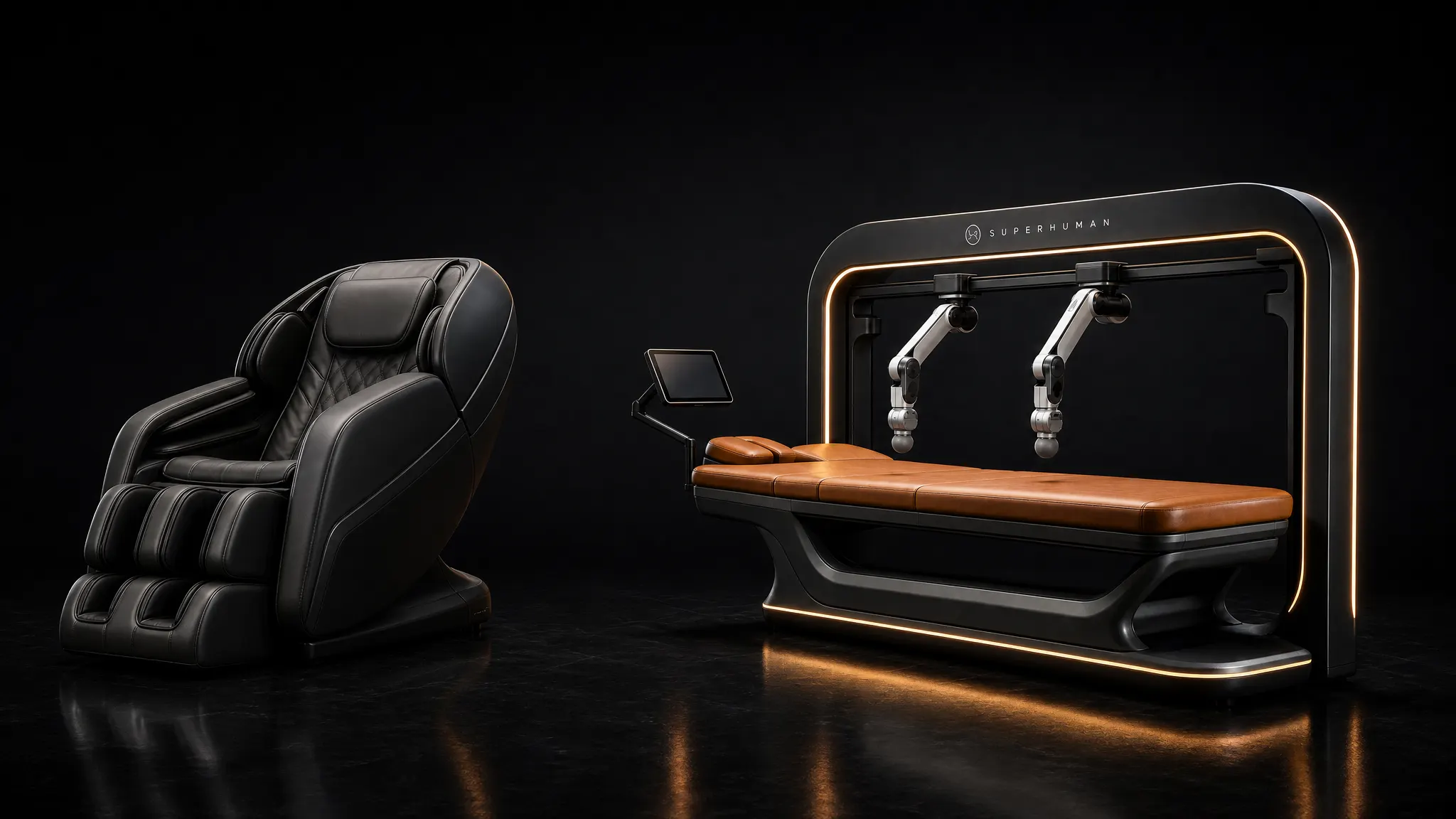
A massage robot and a massage chair are not the same product. A massage chair is a seat with rollers and airbags that runs a fixed program. A massage robot is a padded table with robotic arms that scan the guest’s body and work across it, much like a therapist’s hands. Chairs cost less and fit anywhere. Robots cost more, need a room, and give you a full massage session you can book and sell.
Search engines often mix the two up. This page sets out the differences so you can pick the right one for your space and your guests.
The short answer
- Choose a massage chair if you want a low-cost amenity for a lounge, waiting room or locker room, with sessions of 10 to 20 minutes and no booking.
- Choose a massage robot if you want a bookable service of 30 to 60 minutes that covers the full back and legs, runs without a therapist in the room and earns per-session revenue.
Many businesses end up with both. The chair sits in the lobby. The robot has its own room.
How each one works
Massage chair
A massage chair holds the guest in a seated or reclined position. A roller track runs up and down the spine. Airbags squeeze the arms, calves and feet. Some models add heat, zero-gravity recline and body-length detection. The chair follows a preset program, and the guest picks intensity from a remote.
The limits come from the seat itself. The rollers can only reach what is pressed against the backrest. The glutes, the backs of the legs and the sides of the shoulders get little direct work.
Massage robot
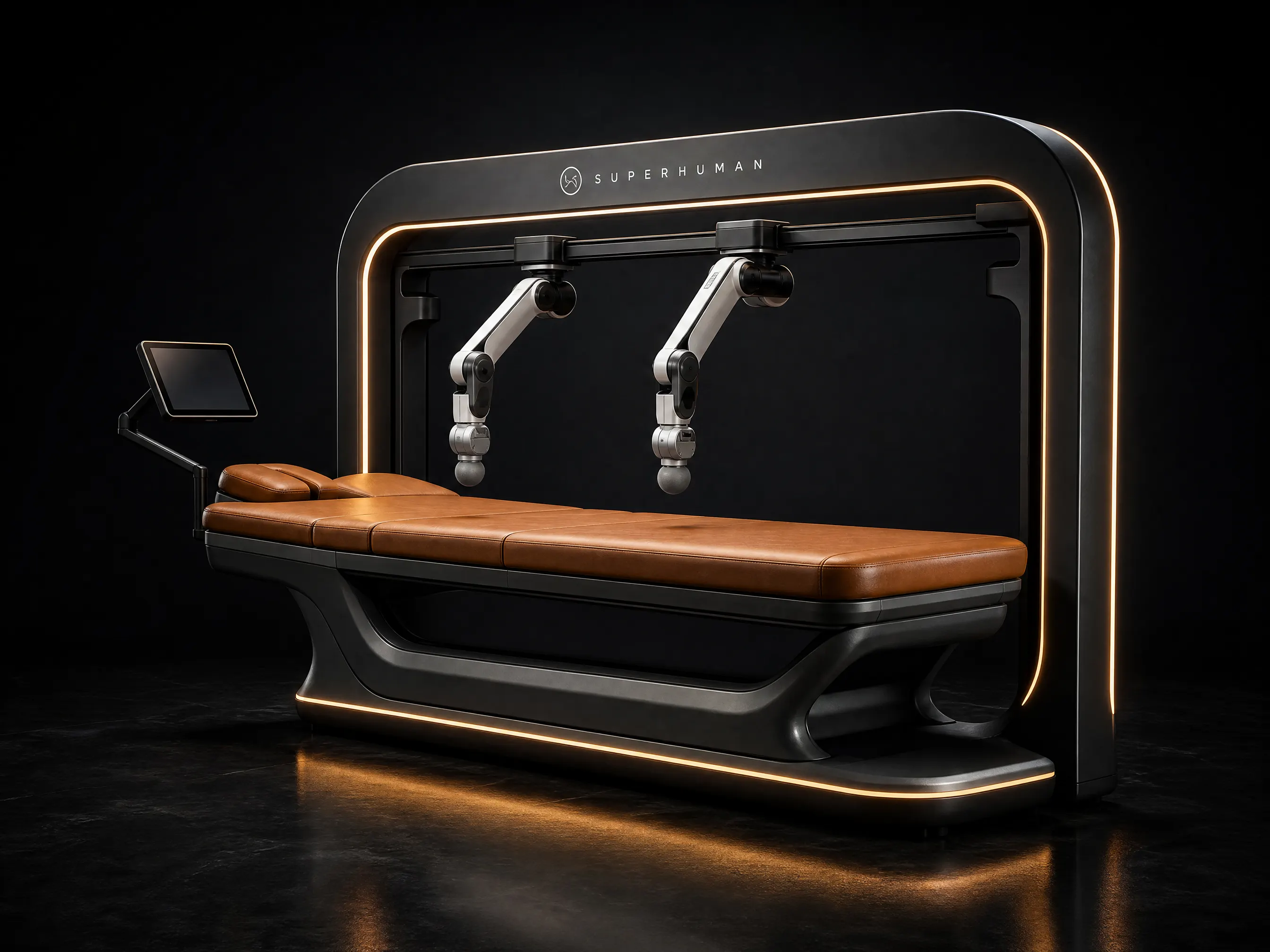
A commercial massage robot uses one or two articulated robotic arms mounted over a padded table. The guest lies face down. The robot scans the body first, then moves its end tools along the muscles, adjusting to the guest’s shape and the pressure they choose.
The Superhuman Touch T1 is a typical example of the format:
- A padded massage table with two articulated robotic arms on a rail frame
- A 3D body scan before each session
- Programmable routines for back, shoulders, neck, glutes and legs
- Pressure set by the guest
- Force limiting, a guest stop button within reach, collision detection and remote monitoring
For a fuller explanation, see how massage robots work.
Side-by-side comparison
| Massage chair | Massage robot (T1 as example) | |
|---|---|---|
| Mechanism | Rollers on a track, airbags, optional heat | Two robotic arms over a table, guided by a 3D body scan |
| Body position | Seated or reclined | Lying face down on a padded table |
| Coverage | Spine, neck, arms, calves, feet; limited glute and hamstring work | Back, shoulders, neck, glutes and legs |
| Personalisation | Body-length scan on some models; preset programs | Scan before every session; routines fit to the guest; guest sets pressure |
| Typical session | 10–20 minutes, walk-up | 30–60 minutes, booked |
| Guest attire | Clothed | Clothed in fitted athletic wear |
| Staff needed | None | Check-in and start; no therapist in the room |
| Throughput | Several short sessions per hour | About 1 guest per hour including changeover |
| Purchase price | About $1,000–$15,000 | Entry $13,000–23,000; T1 $64,900; flagship $125,000–150,000 |
| Space | A corner of a lounge | 2.4 x 1.6 m footprint; 3.0 x 2.6 m private room |
| Power | Standard outlet | 120 V or 240 V, dedicated 20 A circuit |
| Business model | Free amenity or low-price add-on | Bookable service sold per session or in memberships |
Chair prices come from a major chair maker’s own price guide (see Sources). Robot price bands reflect public prices we found across the market. Our full breakdown is on the massage robot cost page.
Session type: amenity vs service
This is the biggest practical difference.
A chair is something a guest uses while they wait. Sessions are short, nobody books them, and few guests will pay much for them. Most businesses list a chair as a perk.
A robot session is something a guest books. It runs 30 to 60 minutes in a private room. It fits on a service menu next to massage, cryotherapy or compression. That means you can price it, put it in a membership tier, or sell packs of sessions.
If your goal is new revenue, the robot is the stronger fit. If your goal is a nice touch in the lobby, the chair is enough.
Price bands and running costs
Massage chairs. Budget chairs sell for about $1,000 to $5,000. High-end and top-tier chairs run about $6,000 to $15,000. Commercial chairs built for heavy public use can cost more. Running costs are small: a standard outlet and occasional repairs.
Massage robots. Public prices fall into three rough bands:
| Band | Typical price | What you get |
|---|---|---|
| Entry | About $13,000–23,000 | Single arm, often sold for home or light commercial use |
| Mid | About $60,000 | Full commercial table, two arms, body scan |
| Flagship | About $125,000–150,000 | Premium commercial systems, often with annual platform fees |
The T1 sits in the mid band at $64,900, or about $1,350 per month with financing (60 months, on approved credit). You own the machine. Electricity runs about $40 to $80 per month. Delivery, installation, calibration, one-day staff training, a 2-year parts and labour warranty, remote monitoring and software updates are included.
Space and installation
A chair needs about the floor area of a large armchair plus recline room. It plugs into a wall outlet. You can move it later.
A massage robot needs a room. For the T1 plan for:
- Footprint: 2.4 x 1.6 m
- Room: about 3.0 x 2.6 m, private and quiet
- Power: 120 V or 240 V on a dedicated 20 A circuit
- Network: Wi-Fi or Ethernet for updates, booking and remote support
Many sites convert an unused treatment room, an office or part of a locker area. We confirm the details in a site spec before you order.
Business fit by venue
| Venue | Chair fits when | Robot fits when |
|---|---|---|
| Gym or recovery studio | You want a free perk near the locker rooms | You want a paid recovery service or a premium membership tier. See massage robots for gyms. |
| Day spa | You need something in the relaxation lounge | You need to cover open slots and off-peak hours without extra therapists. See massage robots for spas. |
| Hotel or resort | You want a lobby or lounge amenity | You want a 24/7 wellness offer for guests. See massage robots for hotels. |
| PT or chiropractic clinic | You want something for the waiting room | You want a wellness add-on between appointments, under your own clinical judgement. |
| Corporate wellness | You want a break-room perk | You want a bookable benefit staff will schedule |
What neither one replaces
Neither device is a medical treatment. Both are wellness products. Guests with injuries, pregnancy, heart conditions or other health concerns should check with their physician first. Neither replaces a skilled massage therapist for targeted work. We cover that in massage robot vs massage therapist.
How to decide
Ask three questions:
- Do you want to sell sessions, or offer a perk? Selling points to a robot. A perk points to a chair.
- Do you have a spare private room and a 20 A circuit? If not, a chair is the practical choice for now.
- What can you spend per month? A chair is a one-off cost. A T1 is about $1,350 per month financed, against the revenue it brings in.
If the answers point to a robot, start with the Superhuman Touch T1 or browse massage robots for sale.
Superhuman Touch T1
A full-body massage that never calls in sick.
- Arms
- 2 robotic arms
- Session
- 30–60 min
- Guest
- Stays clothed
- Power
- 120/240 V · 20 A
Sources
- Panasonic Massage Chairs, “How Much Do Massage Chairs Cost?”: https://www.panasonicmassagechairs.com/how-much-do-massage-chairs-cost/
- Alfine Titanium III product page (entry robot price): https://alfine.org/products/alfine-titanium-ii-massage-robot
- Aescape One pre-order page (flagship price): https://one.aescape.com/products/aescape-one-pre-order
- Capsix iYU for business (flagship price): https://www.capsix.com/en/business/