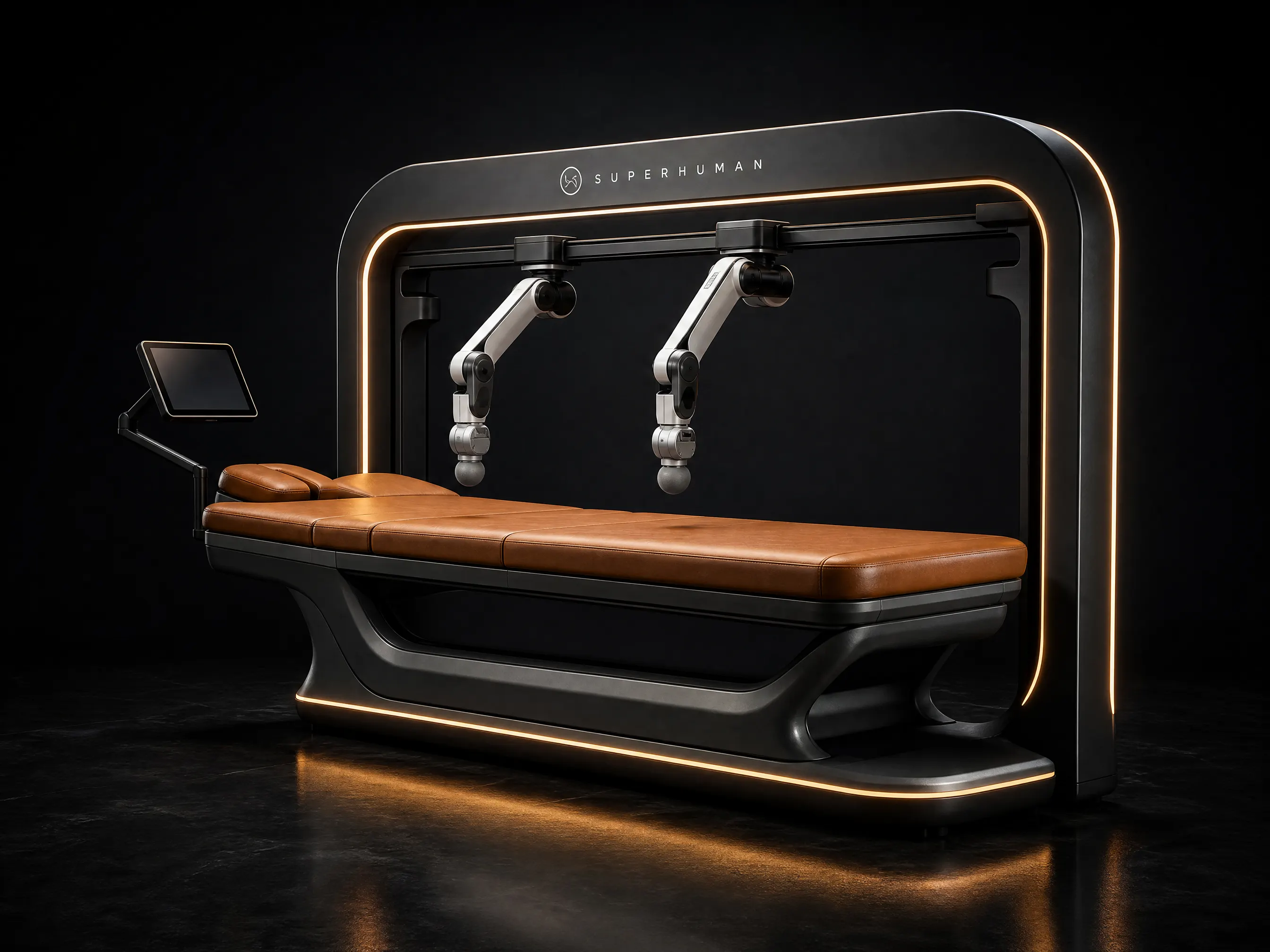
A commercial massage robot is a padded table with robotic arms that scan a guest’s body and deliver a full massage with no therapist in the room. It is built to run paying sessions all day, with safety systems, remote monitoring and a service plan behind it. The Superhuman Touch T1 is our commercial dual-arm robot at $64,900.
If you searched for a commercial massage robot and found pages full of massage chairs, you are not alone. This guide explains the difference and what a business should demand before it buys.
Robot vs chair: the short answer
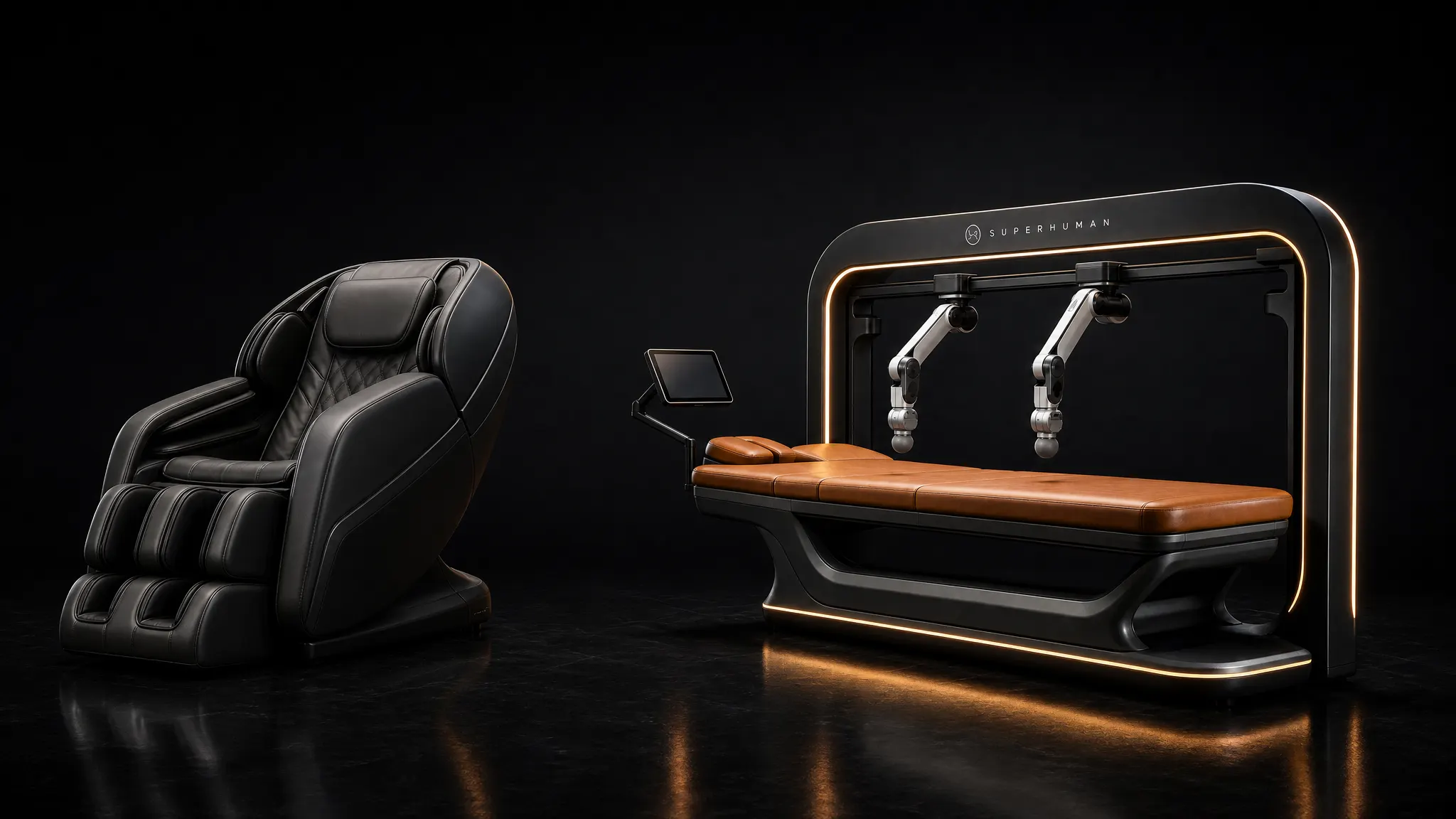
Massage chairs are a seat with rollers. Massage robots are arms with a table.
A massage chair moves rollers and airbags along a fixed track behind a reclining seat. It is a good amenity in a lounge or a waiting area. A massage robot uses articulated arms that travel over the body, guided by a 3D scan, while the guest lies on a padded table. It sells like a massage service, not a seat.
| Commercial massage chair | Commercial massage robot | |
|---|---|---|
| Hardware | Seat, rollers, airbags | Padded table, two robotic arms on a rail frame |
| Body fit | Fixed track, preset sizes | 3D body scan before each session |
| Pressure | Preset levels | Guest sets the pressure, arms apply it |
| Areas | Back, neck, sometimes legs and feet | Back, shoulders, neck, glutes and legs |
| Session | Usually 10–20 minutes | 30–60 minutes |
| What you can charge | Often free or a small add-on | Locations charge $60 or more per session |
| Price | A few thousand dollars | About $13k–150k depending on tier |
For the full comparison, read massage robot vs massage chair.
What makes a massage robot commercial
A home gadget and a commercial machine can look alike in photos. Under the cover, the demands are very different.
Duty cycle
A commercial robot needs to run back-to-back sessions for 10 to 16 hours a day, every day. Ask the vendor:
- How many sessions per day is it rated for?
- How long between sessions does it need?
- What parts wear and when do they get replaced?
The T1 runs 30–60 minute sessions at about 1 guest per hour including changeover.
Safety
Guests are alone with the machine. Safety has to be built in, not bolted on. Look for:
- Force limiting so the arms cannot press harder than set limits.
- A guest stop button within reach at all times.
- Collision detection that stops the arms if something unexpected is in the way.
- Remote monitoring so faults are seen quickly.
The T1 has all four. Read more on the massage robot safety page.
Service and warranty
A machine that is down earns nothing. Ask:
- How long is the parts and labour warranty?
- Who does repairs, and how quickly?
- Can the vendor diagnose faults remotely?
- What does service cost after the warranty?
The T1 includes a 2-year parts and labour warranty, remote monitoring and software updates. See service and warranty.
Uptime and software
A commercial robot depends on software for routines, guest profiles and safety logic. You need updates for years. Ask how updates are delivered, whether they cost extra, and what happens to support if the vendor is sold or restructured. Vendor stability is a fair question for any company, including us.
Site requirements
Commercial robots need a proper room and power. The T1 needs:
| Requirement | T1 |
|---|---|
| Footprint | 2.4 × 1.6 m |
| Recommended room | 3.0 × 2.6 m, private and quiet |
| Power | 120 V or 240 V, dedicated 20 A circuit |
| Network | Wi-Fi or Ethernet |
| Running cost | About $40–80 a month in electricity |
Guest experience
Guests stay clothed in fitted athletic wear. There is no undressing and no draping, which keeps the room simple to run. The guest uses a touchscreen and pressure control. Voice prompts guide the session. Staff use an operator dashboard.
Compliance
Ask for electrical listing and safety documentation in writing. For the T1, compliance documentation is supplied with your written quote. The T1 is a wellness device. We do not claim FDA clearance or medical benefits. Guests with health conditions should check with a physician first.
How a commercial session runs
A good commercial robot fits into the way your front desk already works. Here is a typical T1 session.
- Check-in. The guest books online or at the desk. Staff confirm the booking and show them to the room.
- Setup. The guest lies face down on the table in fitted athletic wear. Staff start the session from the operator dashboard, or the guest starts it from the touchscreen.
- Body scan. The robot runs a 3D scan to map the guest’s shape and size, then fits the routine to them.
- Massage. The arms work through the chosen routine on the back, shoulders, neck, glutes and legs. The guest can change pressure at any time and has a stop button within reach.
- Finish and reset. The session ends with a voice prompt. The guest leaves, and staff wipe down the table and face cradle.
The whole cycle takes about an hour, including changeover. Staff time per session is a few minutes at check-in and reset. Guest preferences are saved, so the next booking starts where the last one left off.
Training your team
Staff do not need massage training to run a commercial robot. They need to know the guest flow, the cleaning routine and what to do if a guest presses stop. The T1 price includes one day of on-site training, covering:
- Starting, pausing and ending sessions
- Guest screening questions and when to suggest a physician check first
- Cleaning between guests
- Reading the operator dashboard and reporting a fault
Remote monitoring means our team often sees a fault before your staff do.
Commercial buying checklist
Use this before you sign with any vendor.
- Is the price public, and what does it include?
- Is it a purchase, a finance agreement or a lease?
- Is there a yearly platform or software fee?
- How long is the warranty, and what does it cover?
- What are the safety systems?
- What room size and power do you need?
- How many guests per hour, including changeover?
- Who installs it and trains your staff?
- How is the vendor funded, and who supports the software long term?
- What documentation comes with the quote?
Where commercial massage robots fit
Robots work best where demand is real but staffing is hard. They cover hours and capacity. They do not replace skilled therapists, who still handle the guests and the work that need a human.
- Gyms and recovery studios: a bookable recovery service without hiring. See massage robot for gyms.
- Day spas: extra capacity for evenings and weekends. See massage robot for spas.
- Hotels and resorts: a wellness amenity open early and late. See massage robot for hotels.
- Physical therapy and chiropractic clinics: a consistent, self-paced add-on. See massage robot for physical therapy.
- Corporate wellness: a perk staff can book between meetings. Contact us to talk through your site.
Cost and return
Commercial massage robots range from about $13,000 for entry systems to $150,000 for flagships. The T1 is $64,900 with delivery, install, training and a 2-year warranty included. Financing runs about $1,350 a month over 60 months (OAC), and you own the machine. Market leases start around $2,700 a month.
At $60 a session, about 28 sessions a month cover the T1’s financing and running costs. That figure is illustrative. See massage robot cost for the full breakdown and massage robot ROI to run your own numbers.
The Superhuman Touch T1
See full specs on the T1 product page, compare the category on massage robots for sale, or contact us for a written quote and site spec.